
What a rural priest in late-nineteenth-century France actually earned
The story attached to Rennes-le-Château depends, at every point, on a contrast: a poor priest who suddenly spends money he cannot have had. The contrast is real. But it only means anything if you know what the priest's legitimate income actually was — the baseline against which the spending has to be measured.
The post-Concordat framework
The legal structure governing parish income in Saunière's lifetime was the Concordat of 1801, struck between Napoleon Bonaparte and Pope Pius VII, and still in force when Bérenger Saunière arrived at Rennes-le-Château in 1885. Under its terms, the French state paid the stipends — traitements — of ordained clergy in active posts, treating them in effect as salaried functionaries of a regulated public service. The Concordat placed priests on a formal pay scale that varied by rank: archbishops and bishops at the top, then cathedral canons, then curés of first-class and second-class parishes, and finally — at the bottom — the desservants and curés of the smallest rural communes.

Fig. 2Payment for saying masses was ordinary and regulated; taking stipends for far more masses than anyone could say was not.
Rennes-le-Château was at the very bottom of that ladder. It was a fifth-category commune, tiny and remote, on a ridge above the Sals valley in the Aude, with a population that had been falling since the mid-nineteenth century and stood at only a few hundred by the time Saunière took the post. A priest serving such a commune received a state stipend that was modest by any measure: approximately nine hundred francs a year in the 1880s, a figure that placed him comfortably below the earnings of a skilled urban tradesman. The Organic Articles appended to the Concordat allowed departments and communes to supplement this figure from local funds, but a commune as small and as poor as Rennes-le-Château was in no position to add anything meaningful.
What the stipend actually covered
Nine hundred francs a year sounds abstract. Set against the cost of living in rural Languedoc in the last quarter of the nineteenth century, it meant a priest could feed and clothe himself, maintain a basic household, and meet the running costs of his church at a very modest level — and not much more. The presbytery — the priest's house — was provided by the commune, so there was no rent to pay, but the building at Rennes-le-Château was in poor repair, and Saunière's early letters to the Diocese of Carcassonne document the discomfort plainly.
The priest was also expected to maintain the fabric of his church from his own resources beyond what the commune's municipal budget — always limited — could provide. The church of Saint Mary Magdalene was in a deteriorated state when Saunière arrived: roof, floor and furnishings all needed attention. A rural curé of this class had no reserve from which to fund serious repair. He was dependent on small grants from the diocesan authority at Carcassonne, on the commune's own slender means, and on whatever his parishioners could raise. The documented grant from the diocese in the late 1880s for the initial phase of repair at Rennes-le-Château was in the region of a few hundred francs — enough to begin a modest restoration, not enough to complete one.
Mass stipends and their regulation
On top of the state stipend, a priest could legitimately earn fees for specific religious services. Masses said for the dead — requiem masses and anniversary masses for the intentions of named individuals — were the most significant source of supplementary income. A priest accepting a fee to say a mass for a donor's stated intention was receiving a mass stipend, a practice that was both ancient and closely regulated by canon law. The scale of the permitted fee was fixed by the bishop of each diocese; in the Diocese of Carcassonne in this period it was a matter of a franc or a franc and a half per mass. A priest who said a daily mass for an outside intention could therefore earn a legitimate supplement, but one that was measured, across a year, in hundreds of francs rather than thousands.
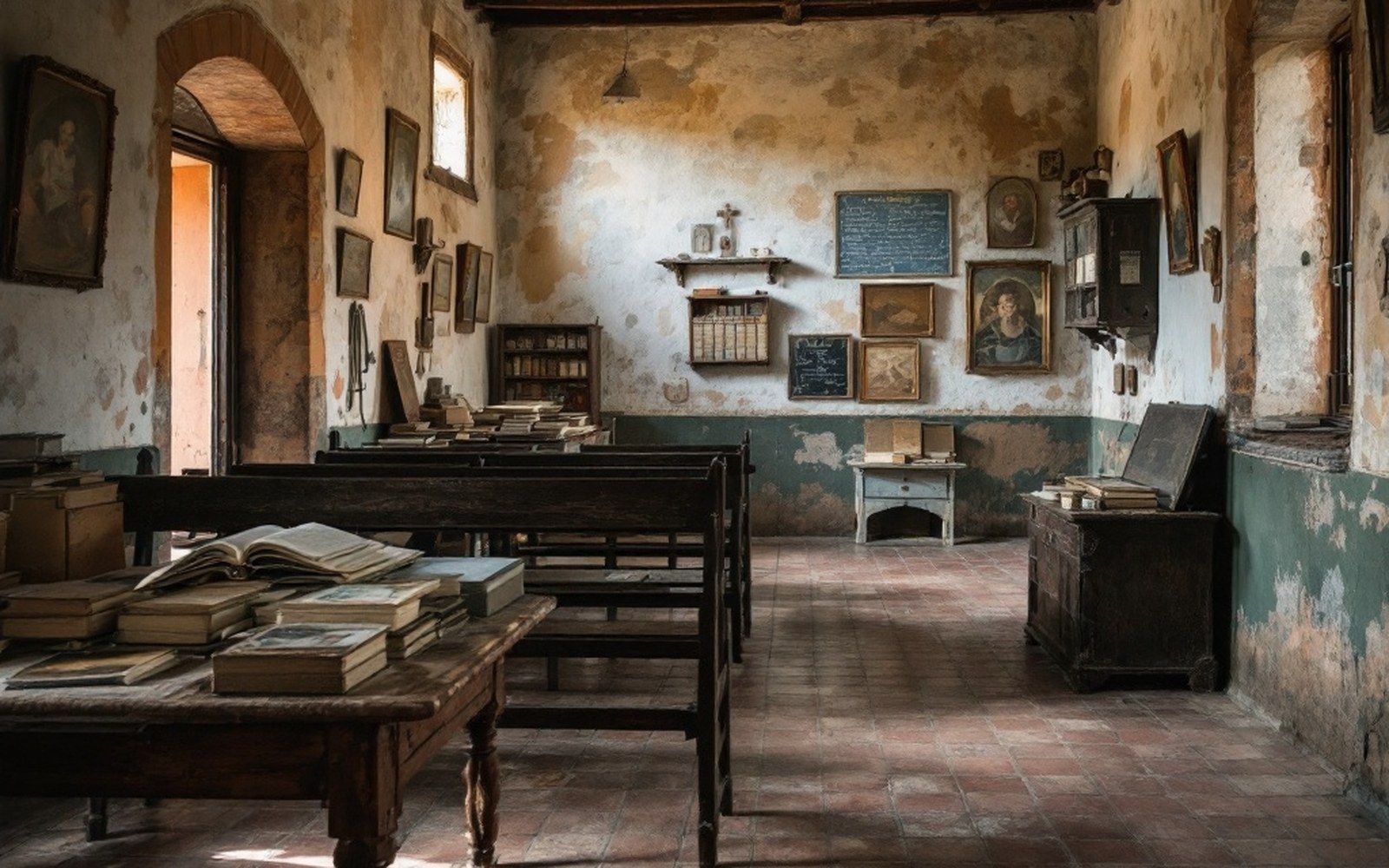
Fig. 3Painted plaster and a tiled floor: the refurbishment is the reason the church is known at all.
Canon law was equally precise about the limits. A priest could not take more stipends than he could personally discharge by celebrating the required masses himself. If he received more requests than he could fulfil, he was obliged to transfer the surplus to other priests, passing the fee on accordingly. The boundary between licit accumulation and the offence of simony — trading in sacred things — was policed, in principle, by the diocesan bishop. It was the systematic breach of this rule, on a scale the Diocese of Carcassonne found impossible to ignore, that eventually brought Saunière before the ecclesiastical court presided over by Bishop Paul-Félix Beuvain de Beauséjour.
The separation of 1905 and what changed
The framework shifted dramatically with the law of 9 December 1905, which abolished the Concordat regime and ended state payment of clerical salaries. From that date, priests received nothing from the government; their income came entirely from their diocese, from parish collections, and from fees for services. For Saunière, already in conflict with the diocese and increasingly estranged from Bishop de Beauséjour, the timing was damaging. His correspondence and the surviving diocesan papers show a man whose spending had long since outrun any income the church could legitimately supply, and who was now stripped of even the small state stipend that had formed the floor of his finances.
Fig. 4He was tried in an ecclesiastical court and the proceedings survive, which makes the central financial question a matter of record rather than speculation.
The separation did not create the financial irregularity at Rennes-le-Château — the spending had begun in the late 1880s and accelerated through the 1890s — but it removed the fig leaf. After 1905, there was no longer even a theoretical way to present Saunière's expenditure as stretched-but-possible on a priest's legitimate income.
The baseline in practice
The arithmetic is, in the end, simple. Saunière's legitimate annual income across the years of his main building programme — roughly 1896 to 1905 — consisted of a state stipend of the order of nine hundred francs plus whatever he received from mass stipends, collections and small fees. Even at a generous estimate, including legitimate stipend income from masses said within canon law's permitted scale, his total annual income from all proper sources is unlikely to have exceeded fifteen hundred francs in any given year, and was probably less in most of them. Against this, the Archives départementales de l'Aude and the diocesan trial record document expenditure on Villa Bethania, the Tour Magdala, the garden, the refurbished church and its furnishings that ran into tens of thousands of francs over the same period.
That gap is the documented fact at the centre of the story. How it was bridged is a question the surviving record answers only partially — through the mass stipend traffic the trial identified, and through patronage and donations that the accounts partly reflect. What the record does not contain is any treasure, any encoded parchment, any royal bloodline. Those are a later invention, assembled by other people for other reasons, and they have nothing to do with the gap in a rural priest's accounts.