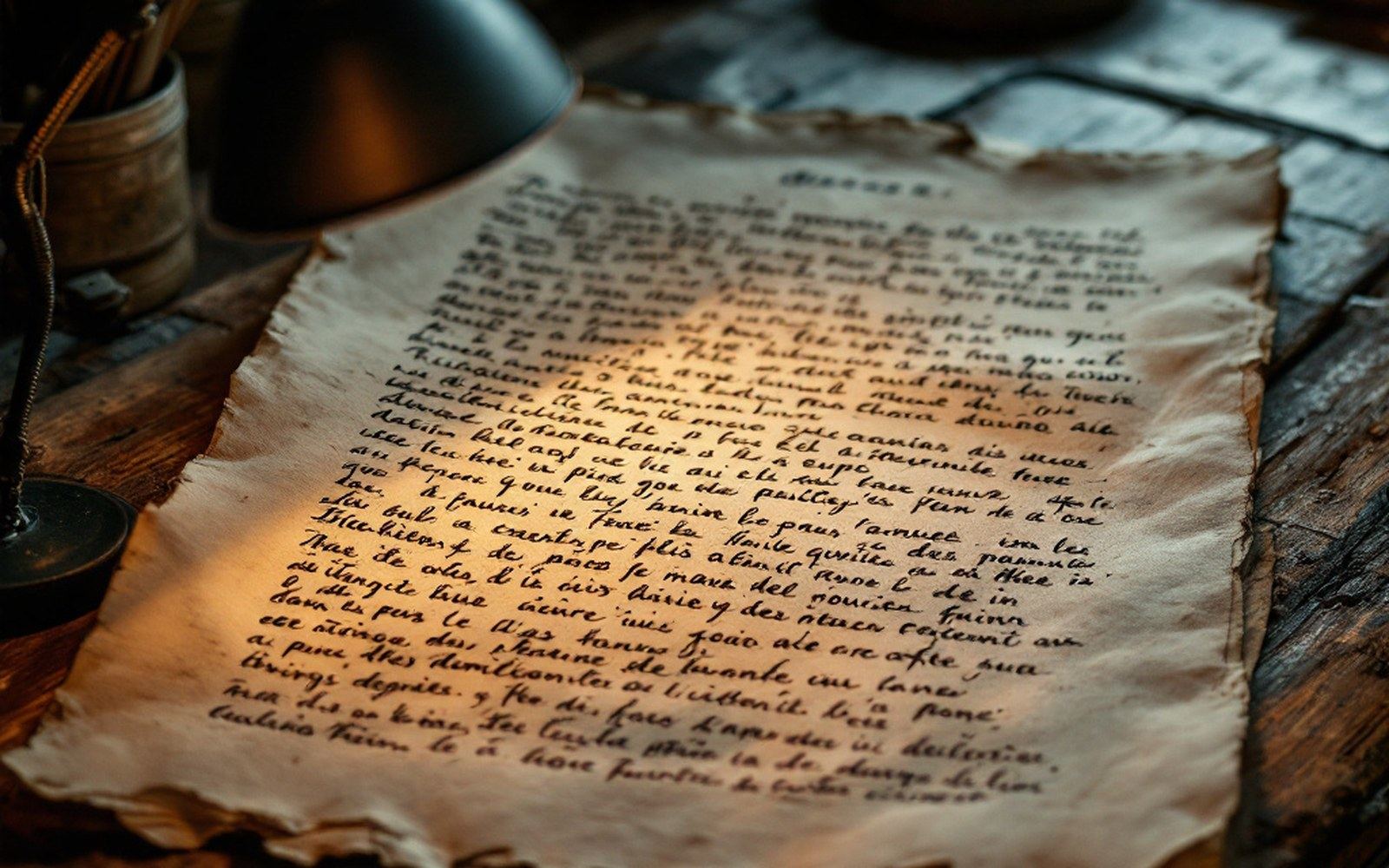
The man who made the parchments
Philippe de Chérisey was a French actor and writer, best known in his lifetime for television comedy work, who in the early 1960s became the principal fabricator of the documentary props underpinning the Rennes-le-Château legend. Working alongside Pierre Plantard, he composed the texts that would later be presented as ancient coded parchments discovered by Bérenger Saunière during the 1890s refurbishment of his church.
Fig. 2The hotelier who bought the estate and told customers a treasure story, which the regional press then printed.
The parchments were deposited at the Bibliothèque nationale de France as part of a wider campaign by Plantard and de Chérisey to seed supposedly authentic documents in verifiable locations — giving their fabrications the appearance of provenance. The texts were densely encoded, visually elaborate, and plainly designed to reward close reading by enthusiasts. De Chérisey did not attempt to conceal this work indefinitely. He later wrote an unpublished manuscript, Pierre et Papier, in which he described how the documents had been constructed. The admission was explicit: he had composed the parchments himself and they were not ancient.
That manuscript circulated among researchers and was eventually examined alongside the deposited papers at the Bibliothèque nationale. It substantially undermined the evidentiary core of the legend, since the parchments had been the most frequently cited physical evidence for the claim that Saunière had discovered something significant during his building works. Remove them as authentic documents, and what remains is a rural priest who spent money he had not disclosed, tried in an ecclesiastical court for the irregular sale of masses — a mundane, if serious, clerical offence — not a man who had stumbled on a medieval secret.
Fig. 3The tower at the edge of the drop, built as a library.
De Chérisey's technical skill mattered to the legend's longevity. The encoding he applied to the parchment texts was real cryptographic work, sufficiently complex to sustain years of amateur analysis. The Bibliothèque nationale de France's catalogue records the deposited materials as modern documents, not medieval ones, which is consistent with what de Chérisey himself wrote. Scholarly treatments of the affair, including the detailed account given in Bill Putnam and John Edwin Wood's The Treasure of Rennes-le-Château: A Mystery Explained (2003), conclude that de Chérisey's own confession is the most direct evidence available, and that it corroborates the material analysis of the documents.

Fig. 4Local newspaper articles of the mid-1950s are the first appearance in print, and they can be dated precisely.
He died in 1985. His role is now the clearest documented link between the fictional apparatus of the legend and a named individual who both constructed that apparatus and recorded having done so — a relatively unusual situation in the history of literary hoaxes.