
The man who needed a genealogy
Pierre Plantard was born in Paris in 1920 and died there in 2000. He was, by most accounts, a man of modest practical achievement but considerable imaginative ambition — the kind of figure who constructs an elaborate personal mythology and then, by persistence and audacity, persuades others to treat it as history. His connection to Rennes-le-Château was not original: he inherited the village's nascent legend from Noël Corbu, the hotelier whose tableside treasure story had been circulating in the regional press since the mid-1950s. What Plantard added was a genealogy, a supporting cast of fabricated documents, and a claimed organisation whose statutes he filed with the French authorities in 1956 under the name the Priory of Sion.
The Priory registered as a small social club in Annemasse, Haute-Savoie — a routine déclaration under French associative law, obliging it to nothing more than a list of officers and a declared purpose. The declared purpose was anodyne. The name, however, was available to be retrospectively inflated, and inflation was what followed over the next two decades, largely through Plantard's collaboration with Philippe de Chérisey, a writer and wit who later admitted composing the supposedly medieval parchments that underpinned the whole construction.

Fig. 2The hotelier who bought the estate and told customers a treasure story, which the regional press then printed.
The dossiers secrets and the Bibliothèque nationale
The mechanism Plantard used to give his claims the appearance of documented history was the deposit of papers in a public institution. Between the late 1960s and the early 1980s, a collection of documents known collectively as the dossiers secrets — the secret dossiers — was lodged in the Bibliothèque nationale de France under the name Henri Lobineau, a pseudonym. The dossiers purported to trace the genealogy of the Merovingian dynasty through the medieval period and into the modern era, arriving eventually at Pierre Plantard himself as a lineal descendant of the Merovingian king Dagobert II.
The documents were accessible to researchers using the library's collections, which gave them a surface credibility that private claims would not have had. A reader who located them in the catalogue was encountering something that appeared to have independent existence and institutional custody. That appearance was the point. The dossiers were not written by medieval scribes or early modern genealogists; they were assembled by Plantard and de Chérisey and deposited to be found. The genealogical charts they contained were inventions, and the names they listed as grand masters of the Priory of Sion — a roster running from figures of genuine historical distinction to Leonardo da Vinci and Isaac Newton — were Plantard's own composition.
This was the structure that the 1982 book The Holy Blood and the Holy Grail, by Michael Baigent, Richard Leigh and Henry Lincoln, took as its primary source, treating the deposited papers as evidence of a suppressed historical truth rather than as the fabrication they were. The book reached a large international audience and established the version of events that would eventually reach an even wider one through the 2003 novel The Da Vinci Code. Neither work originated the claims; both amplified Plantard's framework far beyond anything he had managed to achieve alone.
The 1993 investigation
The mechanism collapsed publicly in 1993, when the French investigating magistrate Thierry Jean-Pierre, conducting a separate fraud investigation, summoned Plantard for questioning. In the course of that inquiry, searches of Plantard's home turned up documents he had prepared identifying himself as the true King of France. Under oath, Plantard conceded that he had fabricated the Priory of Sion's medieval lineage. The genealogical claims to Merovingian descent, the list of grand masters, the whole historical apparatus — he admitted these were his own inventions.
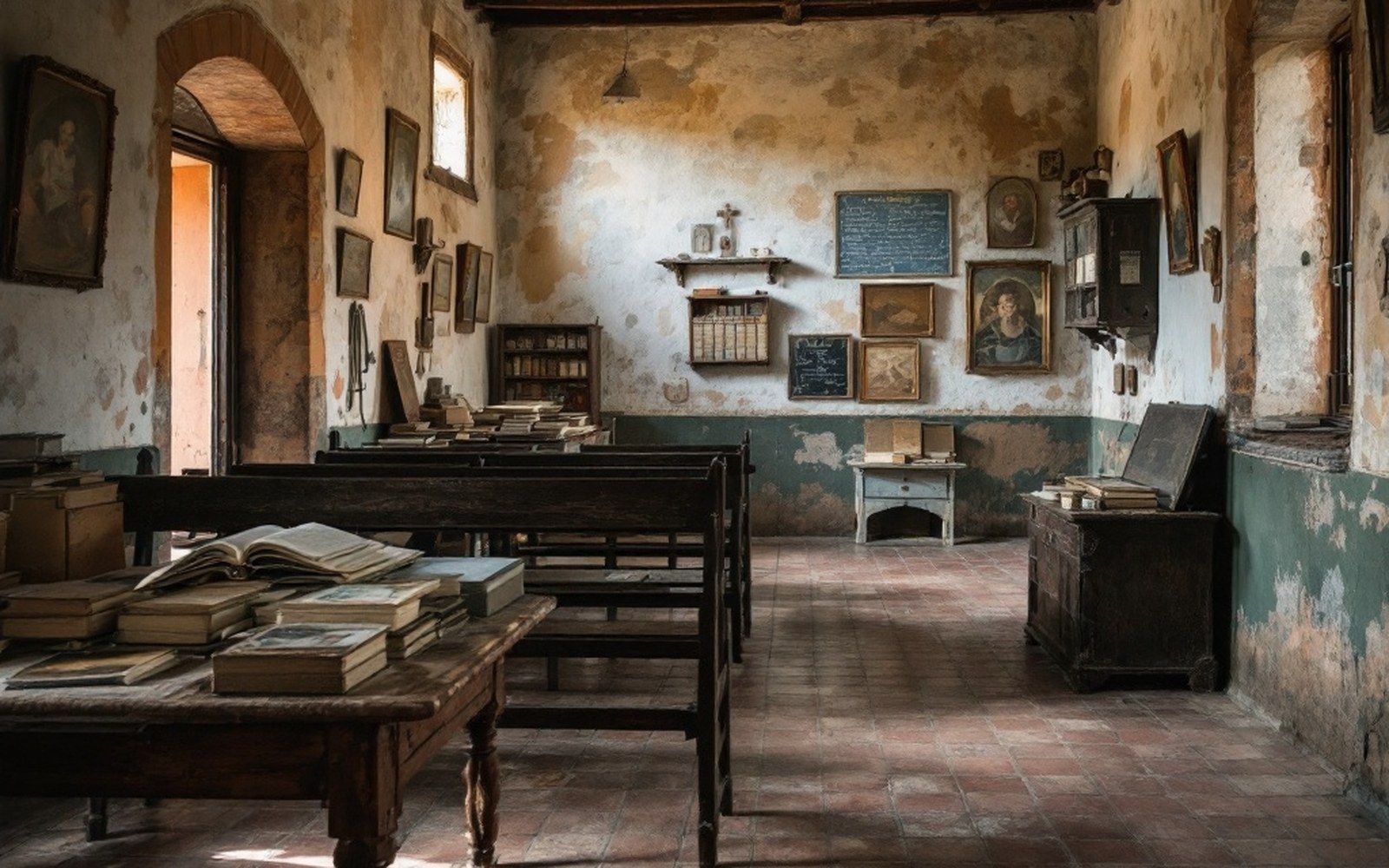
Fig. 3Painted plaster and a tiled floor: the refurbishment is the reason the church is known at all.
The researcher who had done most to document the fabrication before 1993 was the French writer Jean-Luc Chaumeil, who had known Plantard personally from the early 1970s and had accumulated correspondence and testimony over the following decade. The British researchers Paul Smith and others working in the anglophone sphere pursued parallel lines of enquiry, tracking the paper trail of the dossiers back to their point of assembly rather than their claimed point of origin. By the time Plantard gave his sworn testimony, the intellectual case against his documents was already substantially made; what 1993 added was his own admission under judicial examination.
Philippe de Chérisey had in fact preceded that admission by years. In a document sometimes called La Pierre et le Papier (The Stone and the Paper), de Chérisey described his own role in composing the coded parchments that Plantard's story required — parchments that in the story had been discovered by Bérenger Saunière during the refurbishment of the church at Rennes-le-Château in the 1890s. The diocesan trial of Saunière, whose proceedings survive in the ecclesiastical record, turns on his sale of mass stipends — simony, in canon law, not the possession of encoded medieval genealogies. The parchments had no connection to the real history of the village.

Fig. 4Local newspaper articles of the mid-1950s are the first appearance in print, and they can be dated precisely.
What the record shows
What Pierre Plantard actually was, as distinct from what he claimed, is visible in a number of genuine documents. A 1953 conviction in France for fraud and embezzlement — a matter of public judicial record — predates his Rennes-le-Château involvement and is part of the context in which his later documentary fabrications have to be understood. His early enthusiasms ran to esoteric nationalism and the kind of heraldic self-invention common among a certain type of mid-twentieth-century French eccentric; he had attempted to found societies and publish newsletters before the Priory of Sion gave him a more durable vehicle.
The archives that document the real history of Rennes-le-Château — the Archives départementales de l'Aude for civil records, the diocesan holdings in Carcassonne for ecclesiastical ones — contain no trace of Plantard's claims because those claims had no origin in the village's actual past. The fortune that Bérenger Saunière spent on the Villa Bethania, the Tour Magdala and the refurbishment of the church of Saint Mary Magdalene came from the sale of mass stipends across France and possibly from the patronage of wealthy visitors, not from a hidden cache whose secret was encoded in parchments now known to have been typed on a mid-twentieth-century typewriter.
Pierre Plantard spent roughly forty years building and defending a fiction. The judicial examination of 1993 ended it publicly, but the documents he deposited in the Bibliothèque nationale remain in the catalogue, available to anyone who wishes to examine what a fabrication looks like when it has been made to resemble an archive. That availability is, in its way, useful: the dossiers are primary sources for the history of the legend, even though they are not primary sources for anything else.