
What the archives hold
Departmental archives in France — one per département, the administrative divisions established after the Revolution — are the primary repository for civil records produced within their territory. The Archives départementales de l'Aude, held in Carcassonne, preserve the documents generated by notaries, land registries, municipal administrations and civil courts across the Aude since the late eighteenth century. For Rennes-le-Château specifically, this means the register of landed property, notarial acts — the formal instruments drawn up by a licensed notary for sales, donations, loans and successions — and the civil registers of birth, marriage and death that French law has required communes to maintain since 1792.

Fig. 2Where the ecclesiastical papers are held, and what kind of document survives there.
These are the records that anchor real dates to real transactions. When Bérenger Saunière began acquiring and improving property in the 1890s and early 1900s, each significant step left a paper trace in one of these categories. The land registry shows what was bought, in whose name it was registered, and at what declared value. Notarial acts name the parties, the sums and the dates. Marie Dénarnaud appears repeatedly in these instruments as the registered owner of property that Saunière was in practice directing — a documented legal arrangement, not an inference. The civil registers establish the basic biographical facts about both of them that the legend has sometimes obscured or embellished.
What the documents establish
The buildings Saunière put up — Villa Bethania, the Tour Magdala, the garden wall and belvedere — are not mysteries in their physical existence. They appear in the land and property records, and the sequence of their construction can be dated. What the civil record cannot supply on its own is the origin of the money, because private expenditure does not generate a notarial act. The amounts Saunière spent, set against what a rural curé — parish priest — received in stipends and state salary, are the central question, and the civil archive provides only one side of that equation: the spending side, translated into declared property values, which in French practice of this period were routinely understated.
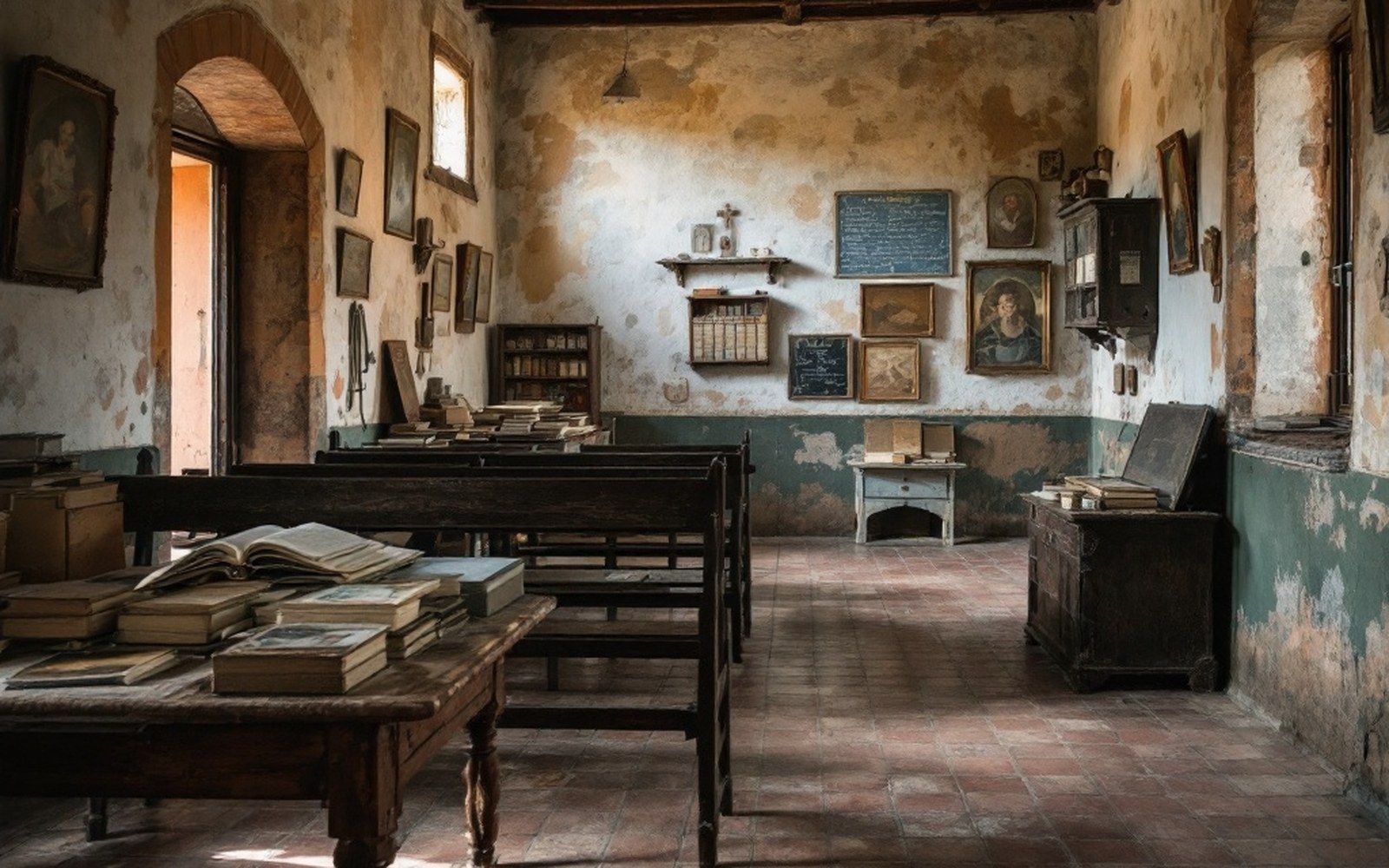
Fig. 3Painted plaster and a tiled floor: the refurbishment is the reason the church is known at all.
The notarial record is also where the succession after Saunière's death in 1917 becomes clear. Dénarnaud inherited the estate and held it until her own death in 1953, when Noël Corbu, who had bought the property from her before she died, took possession. Corbu's subsequent elaboration of a treasure story — told to guests of the hotel he opened in Villa Bethania, and recorded in the regional press from 1956 onward — has no counterpart in the documentary record the archives preserve. The archives contain transactions; the legend was an oral narrative that Corbu added to them.

Fig. 4The published literature is enormous and mostly derivative; a small part of it is based on the archives.
Using the archive
The Archives départementales de l'Aude maintain an online catalogue through which much of their civil holdings — including communal registers for Rennes-le-Château and surrounding communes such as Couiza and Montazels — can be located and in some cases consulted in digitised form. Parish registers predating the Revolution were also deposited here after secularisation, extending the record further back. For researchers tracing the documented history of the village and its buildings, the Aude departmental archive is the starting point: it holds the instruments that make a claim verifiable, and the absence of an instrument — a deed that should exist if a transaction occurred as claimed — is itself informative.
The distinction matters because a significant portion of the printed literature about Rennes-le-Château either ignores the civil record or cites it selectively. What survives in Carcassonne is not colourful, but it is real: property deeds, registration entries, acts drawn up by officers of the law in the ordinary course of their duties, and for that reason worth more than any number of documents whose provenance cannot be traced.